
Unpopular Opinion: 100% Cotton T-Shirts Still Win (Even in the Heat)

By Mike Belobradic, Founder, 1923 Main Street®
This post is a personal point of view shaped by a lifetime of wearing cotton t-shirts and years spent building a boardsports apparel brand around how people actually live in their clothes — not just how fabrics perform on a chart.
Why comfort, character, and real-world wear matter more than fabric specs
If you read enough apparel blogs, product pages, and “best t-shirt for summer” guides (yes, including our own), you could start to think that 100% cotton t-shirts are basically a mistake in hot weather.
Listen to this Story on the 1923 Main Street Podcast
Too heavy. Too hot. Too slow to dry. Too old-school (is that a bad thing?).
Cotton blends, so the story goes, are lighter, more breathable, more technical, and therefore better in every way.
From a purely technical standpoint, that is arguably true. But (and this is a big but), here is my unpopular opinion, shaped by years of wearing and working with casual 100% cotton apparel (and building a boardsports-inspired brand at 1923 Main Street®): the facts do not tell the whole story.
First some full disclosure: as I noted, we are sometimes guilty of playing into the stereotype in our own posts about fabric performance and material science. Stereotype may be too strong, because it’s really about “science” or tech specs more than anything, but you get the idea.
But it dawned on me that all of the posts about “cotton-bad, blends-good” are from a purely technical perspective (almost like a lab experiment). It’s easy to talk about breathability charts and moisture-wicking metrics. But it’s apparently harder to talk about how a shirt actually lives with you over time. So that’s what I’m here to do — to let you know that if you love 100% cotton tees like I do, you can definitely wear them on the hottest and most humid days…if you follow a few basic tips.
There are a lot of us out there who still love cotton tees. And we keep choosing it, even when the internet tells us not to.
So is 100% cotton okay for a t-shirt, or not? I say yes, but first, the villain.
The Seinfeld Problem: When Cotton Became the Villain
Somewhere along the line, cotton became the George Costanza of fabrics. The narrative turned into: “You do not want to be caught dead in this on a hot day.”
If you remember the famous Seinfeld episode where George insists the New York Yankees switch their uniforms to cotton because it’s a natural fabric, only to watch the team melt into a sweaty, unplayable mess, then you know exactly what I mean. That episode became a perfect pop-culture example of everything supposedly bad about cotton.
And yet, walk any beach town, skate spot, Florida theme park, or roadside taco stand in the middle of summer and look around. You will see plenty of people in cotton tees, looking just fine and enjoying life.
The problem is not cotton. The problem is how cotton gets worn.

Performance Logic vs. Real-World Comfort
The big issue as far as I’m concerned is that most fabric advice is written from a performance perspective.
It assumes you are running, hiking, training, or doing something highly aerobic where moisture management is the top priority. That is often the context even we take in posts about the best t-shirts for hot humid weather, or what to wear as a base layer while snowboarding.
“Boardsports culture has always been about feel, not formulas. Cotton fits that mindset better than any spec sheet.”
Mike Belobradic
But here’s the thing: a lot of life in a t-shirt is not a performance sport. It is travel days, boardwalk wandering, post-surf burritos, sketchy roadside gas stations, long drives, and late sunsets in parking lots by the water.
That is where pure cotton shines. It feels natural. It drapes differently. It ages well. It softens over time instead of breaking down into something that feels more synthetic with every wash.
And when it’s a decent-quality cotton (which is what we use at 1923 Main Street®), it does something that blends rarely do: it gets better the longer you own it. The shirt starts to tell a story instead of just holding its shape. That vintage look of a moment in time, aged, preserved and a fit as comfortable as your favorite pair of jeans.
The Cotton “Hack” No One Talks About: Tips for How to Wear Cotton in Heat
Here is the part that most fabric guides leave out (and the reason I decided to write this post): fit and weight of a shirt matter just as much as the fiber.
A lightweight cotton tee, worn a little looser, changes the entire experience.
Airflow beats absorption: A slightly oversized fit lets air move through the shirt instead of trapping heat against your skin.
Lighter weight is everything: Not all cotton is created equal. A lighter fabric can feel dramatically cooler than a heavy, dense cotton knit.
Color plays a role: White and light tones reflect sunlight instead of absorbing it. That alone can make a noticeable difference in direct sun.
Is 100% cotton going to cling on the most brutal, hot, humid days? Sure. But let’s be honest: on those kind of days (when it’s 110°F in Florida in August), is any shirt actually comfortable? That is usually the moment when the right move is to jump in the water, not switch fabric blends.
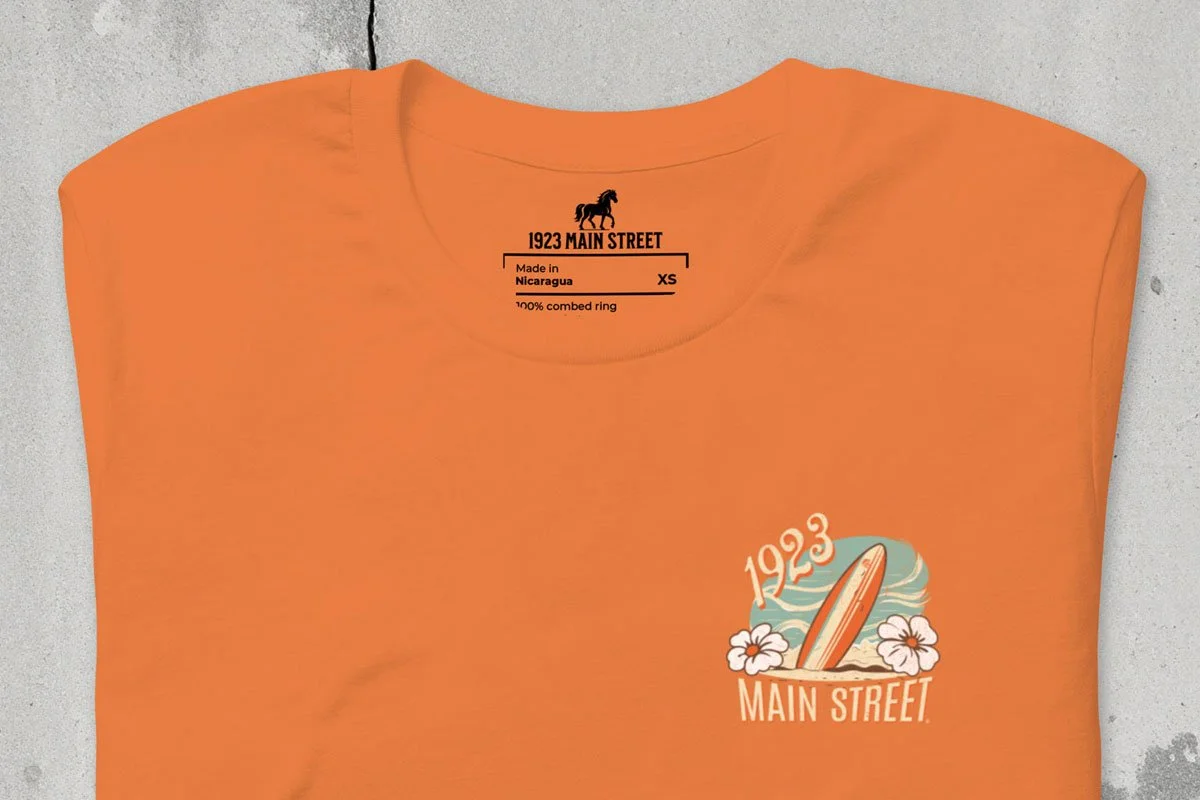
Why We Still Sell So Many Cotton Tees
At 1923 Main Street, we design for skate, surf, snow, and unscripted travel. That means our shirts have to work for real life in all kinds of environments and activities, not just on a product comparison chart.
We still offer blends. They are great products and absolutely have a place. All heathers are blends, for example. But we also keep a strong lineup of 100% cotton tees (the vast majority of our catalog, actually), because people keep choosing them. In fact, the majority of tees we sell are 100% cotton.
Our buyers like the way cotton feels. They like how it hangs on the body. They like how it looks after a year of wear, not only straight out of the package.
And so do I. Even in the dog days of summer, a lightweight, white, loose-fitting cotton tee is still my go-to choice. And it always has been.
So don’t let the naysayers put you off of cotton t-shirts based on a spec sheet or a technical lab approach.
The Real Takeaway When it Comes to Cotton Tees vs Blended Tees
This is not a “blends are bad” argument. It is a “context matters” argument.
If you are training, sweating hard, looking for a snowboarding base layer, or chasing performance, blends often win.
If you are living in your shirt, traveling, skating, surfing, or just moving through the day, cotton still holds its own in ways that do not show up on a spec sheet.
So here is my unpopular opinion: do not shy away from 100% cotton t-shirts just because the internet told you to. Choose better cotton. Wear it smarter. Let it breathe. Let it age.
Sometimes, the best shirt is not the most technical one. It is the one you actually want to put on, day after day.